
Understanding the Qualification Process and How Teams Earned Their Spots
The road to the ICC Men’s T20 World Cup has always been one of the most competitive and nerve-wracking journeys in international cricket. For the 2026 edition, which was co-hosted by India and Sri Lanka and ran from February 7 to March 8, the qualification structure was more detailed and demanding than ever before. The qualification process included two key stages: 12 teams were awarded direct spots while 87 teams competed through regional qualifiers for the remaining 8 places. If you have been following the ICC Men’s T20 World Cup qualifier standings, you already know how dramatic and closely contested this process was across every region of the world.
Which Teams Got Direct Qualification
Before diving into the qualifier standings themselves, it is important to understand which teams did not need to go through the grueling qualifier route. The hosts India and Sri Lanka, along with the top seven teams from the 2024 tournament — Afghanistan, Australia, Bangladesh, England, South Africa, the United States, and the West Indies — directly qualified for the 2026 tournament. Beyond that, the remaining three direct qualification places were allocated to the next best-ranked teams in the ICC Men’s T20I Rankings as of June 30, 2024, which were Ireland, New Zealand, and Pakistan. This left 8 spots to be decided through what became one of the most talked-about qualifier campaigns in recent memory.
How the Regional Qualifier Standings Shaped the Final Field
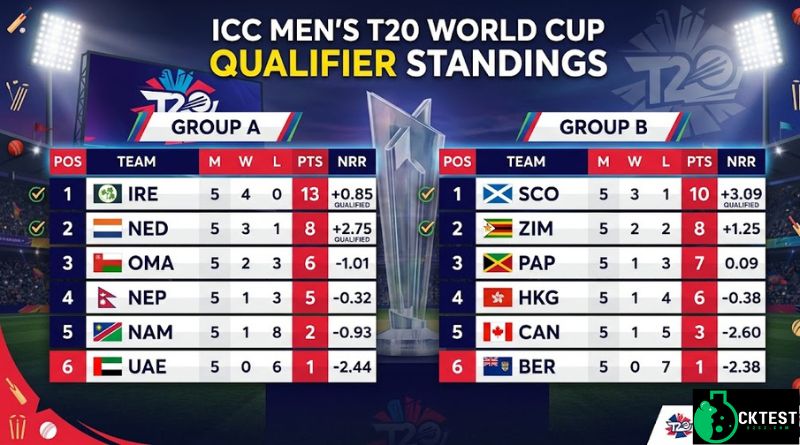
The ICC Men’s T20 World Cup qualifier standings across all regions told fascinating stories of determination and heartbreak. Each region had its own format, its own standout performers, and its own nail-biting moments. The eight remaining places were filled through regional qualifiers, with two teams each from Africa and Europe, three teams combined from Asia and East Asia-Pacific, and one team from the Americas. Following the ICC Men’s T20 World Cup qualifier standings closely, fans could see the momentum building as team after team secured their historic World Cup berths.
Starting with the Americas, Canada qualified after comfortably winning the Americas Regional Final on home soil, winning all six of their games to finish ahead of Bermuda, the Cayman Islands, and the Bahamas. It was a dominant performance that left no doubt about Canada’s readiness for the main stage. In Africa, the regional final was hosted in Zimbabwe, and Namibia and Uganda directly qualified for the regional final after receiving a bye from the 2024 T20 World Cup, with the top two sides — Namibia and Zimbabwe — ultimately securing their spots for the 2026 tournament.
Europe and Asia-EAP Qualifier Standings — The Biggest Stories
Perhaps the most emotional storyline in the entire ICC Men’s T20 World Cup qualifier standings came out of Europe. The Netherlands and Italy qualified after finishing as the top two teams in the European regional qualifiers, with Italy making history by qualifying for a Cricket World Cup for the very first time. It was a landmark moment not just for Italian cricket but for the sport’s global growth as a whole. The Asia-EAP qualifier was equally dramatic, with Nepal, Oman, and the United Arab Emirates all fighting through a tough combined regional final to book their tickets to the main event. These three sides represented some of the most passionate associate cricket nations in the world, and their presence in the standings reflected years of hard work and investment in the game at the grassroots level.
A Late Twist — Scotland’s Unexpected Entry
One of the most unexpected developments in the ICC Men’s T20 World Cup qualifier standings narrative came just weeks before the tournament began. Bangladesh withdrew from the competition following the Bangladesh Cricket Board’s refusal to play in India, and they were replaced by Scotland, the next highest-ranked T20I team. Scotland had actually been eliminated during the European qualifier stage, but their ICC ranking ultimately brought them back into the fold in a dramatic late twist. It was a reminder that the standings and rankings are never just numbers — they carry real consequences that can reshape entire tournament fields overnight.
What the Qualifier Standings Tell Us About Global Cricket
Looking back at the ICC Men’s T20 World Cup qualifier standings in their entirety, the most inspiring takeaway is how far the game has spread. From Europe to the Pacific Islands, from the Americas to East Africa, teams across 87 nations competed passionately for just 8 spots. Across the global pathway, teams competed through regional qualification structures for a limited number of places, with competitive balance improving rapidly across all regions. The qualifier standings are not just a list of winners and losers — they are a snapshot of a sport growing in reach, depth, and ambition with every passing cycle. For cricket fans everywhere, keeping a close eye on the ICC Men’s T20 World Cup qualifier standings has become an essential and exciting part of following the sport’s biggest stage.
Read Also: Kolkata Knight Riders vs Sunrisers Hyderabad Timeline